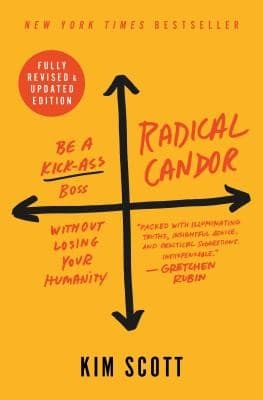
Radical Candor
by Kim Scott
Teaches managers how to give honest, caring feedback that builds trust — essential reading for Indian workplaces where direct feedback is often avoided.
Ask any Indian manager about their biggest challenge and, sooner or later, the conversation turns to feedback. Giving it, receiving it, and the elaborate dance of avoidance that surrounds it. Kim Scott's Radical Candor tackles this problem head-on with a framework so simple and powerful that it has reshaped how some of the world's best companies think about management. For Indian professionals, this book is not just useful — it might be transformative.
The Two-Dimensional Framework
Scott's model plots feedback behaviour on two axes:
- Care Personally — Do you genuinely care about the person as a human being, not just as an employee?
- Challenge Directly — Are you willing to tell people when their work is not good enough?
This creates four quadrants:
- Radical Candor (high care + high challenge) — The goal. You care enough to be honest.
- Ruinous Empathy (high care + low challenge) — You care but avoid hard truths. The person never improves.
- Obnoxious Aggression (low care + high challenge) — Brutal honesty without compassion. Damages relationships.
- Manipulative Insincerity (low care + low challenge) — You neither care nor challenge. The worst quadrant.
The Ruinous Empathy Trap in Indian Workplaces
This is where the book becomes essential reading for Indian managers. Indian workplace culture — influenced by respect for hierarchy, the desire to maintain harmony, and the discomfort with direct confrontation — defaults overwhelmingly to ruinous empathy. Managers avoid giving critical feedback because they do not want to hurt feelings, damage relationships, or create awkwardness.
The result? Underperformers never know they are underperforming. High performers never get the specific guidance that would make them exceptional. Performance reviews become box-ticking exercises filled with vague positives. And the entire team suffers because the manager chose comfort over candour.
Scott's framework names this pattern and exposes its cost. Ruinous empathy is not kind — it is a failure of leadership disguised as niceness. When you avoid telling someone their presentation was unclear, you are not protecting them. You are denying them the information they need to grow.
Building a Feedback Culture
The book goes beyond diagnosis to offer practical tools for building a culture of honest feedback:
- Solicit feedback before giving it. Ask your team to critique your work first. This levels the playing field and signals that feedback flows in all directions.
- Be specific and timely. "Your presentation was bad" is obnoxious aggression. "The third slide had too much data and lost the audience — here is how I would simplify it" is radical candour.
- Praise in public, criticise in private. This is not new advice, but Scott provides nuanced guidance on when and how to do each.
- Focus on the work, not the person. "This code has a bug" is different from "You are careless." The distinction matters enormously.
Performance Reviews, Reimagined
One of the most practical chapters deals with performance reviews. Scott argues that if a performance review contains surprises, you have already failed as a manager. Feedback should be continuous, not annual. By the time you sit down for a formal review, everything should have already been discussed. The review becomes a summary, not a revelation.
For Indian companies still running annual appraisal cycles with forced ranking, this chapter is a wake-up call. The gap between what managers think during the year and what they say during reviews is where trust erodes and attrition spikes.
Who Should Read This
Every manager. Full stop. Whether you lead two people or two hundred, your ability to give and receive honest feedback is the single most important skill in your leadership toolkit. If you work in an Indian organisation — multinational or startup — the cultural tendency toward ruinous empathy makes this book doubly relevant.
Scott writes with warmth and candour herself, drawing on her experiences at Google and Apple. The anecdotes are vivid and memorable, and the framework is easy to internalise and apply immediately.
Final Verdict
Radical Candor is one of the most practical leadership books written in the last decade. It gives you a common language for feedback, a clear framework for improvement, and the courage to say what needs to be said — because you care enough to do so.
Rating: 4.5/5 — Essential for any manager who wants to build a high-trust, high-performance team.