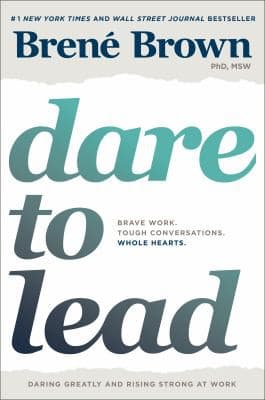
Dare to Lead
by Brené Brown
Brené Brown makes a powerful case for vulnerability and courage as leadership superpowers, offering practical tools to build psychologically safe teams.
Vulnerability is not a word you typically hear in Indian boardrooms. The prevailing leadership narrative — in MNCs and family businesses alike — tends to reward confidence, certainty, and an image of unshakeable control. Brené Brown's Dare to Lead challenges this narrative at its foundations. Drawing on twenty years of research into courage, vulnerability, shame, and empathy, Brown argues that the bravest leaders are not those who have all the answers. They are the ones willing to say "I don't know" and mean it.
Courage Over Armour
Brown's central thesis is that leadership requires courage, and courage requires vulnerability. These are not separate things — they are inseparable. You cannot be brave without first being exposed. Every difficult conversation, every unpopular decision, every moment of honest feedback requires a leader to remove their armour and show up authentically.
The book identifies common "armoured leadership" behaviours: perfectionism, cynicism, numbing out, hoarding power, and avoiding difficult conversations. Brown then maps each of these to a corresponding "daring leadership" behaviour: healthy striving, clarity of values, setting boundaries, sharing power, and leaning into tough talks.
Vulnerability Is Not Weakness
This point cannot be overstated, especially for Indian professionals. Brown's research is unequivocal: vulnerability is not weakness. It is the birthplace of innovation, creativity, and change. When a team leader admits they made a mistake, it does not erode trust — it builds it. When a manager says "I need help with this," it does not signal incompetence — it signals courage.
In Indian corporate culture, where saving face is deeply valued and hierarchy discourages upward vulnerability, Brown's message is both radical and necessary. The manager who pretends to have all the answers creates a team that pretends to have no problems. The leader who models vulnerability creates a team that surfaces issues early, takes calculated risks, and innovates fearlessly.
Psychological Safety
One of the most valuable sections of the book deals with psychological safety — the belief that you can speak up, make mistakes, and be yourself without fear of punishment or humiliation. Brown draws on Amy Edmondson's research and her own findings to argue that psychological safety is the single most important ingredient for high-performing teams.
Building psychological safety requires leaders to normalise failure as a learning opportunity, respond to mistakes with curiosity rather than blame, actively solicit dissenting opinions, and protect people who speak up — even when the message is uncomfortable.
For Indian teams, where the instinct to agree with the senior-most person in the room runs deep, this chapter provides a practical playbook for change. It is not about eliminating respect for experience. It is about creating space for honest dialogue alongside that respect.
Why Indian Corporate Culture Needs This
India's corporate landscape is undergoing a generational shift. Younger professionals increasingly value authenticity, purpose, and work-life integration. They do not want to work for leaders who perform invulnerability. They want to work for leaders who are real. Companies that cling to command-and-control leadership models will lose their best talent to organisations that embrace the kind of leadership Brown describes.
This is not abstract theory. The Indian startup ecosystem has already shown that vulnerability-based leadership works. Founders who openly share their struggles, CEOs who admit strategic pivots, and managers who ask for feedback rather than demand compliance — these leaders build teams that outperform their guarded counterparts.
Practical Tools
Brown provides concrete exercises throughout the book, including "rumble starters" — phrases and practices for initiating difficult conversations. "The story I am telling myself..." is one such tool that allows you to share your interpretation of a situation without presenting it as fact. This single phrase can defuse defensive reactions and open productive dialogue.
Final Verdict
Dare to Lead is not a soft book. It is a rigorous, research-backed argument for a radically different kind of leadership. For Indian professionals who have been taught that strength means never showing doubt, this book offers a more honest and ultimately more effective path forward.
Rating: 4.4/5 — A courageous book for leaders ready to trade armour for authenticity.