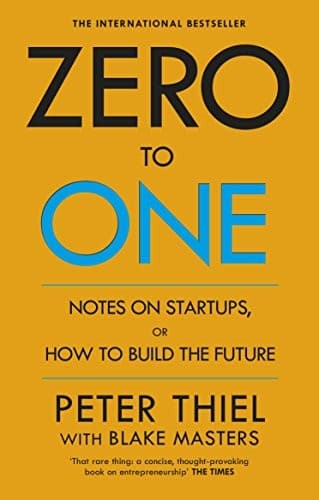
Zero to One
by Peter Thiel
PayPal co-founder Peter Thiel argues that the next big thing won't look like anything that came before. A contrarian guide to thinking about innovation.
Zero to One by Peter Thiel — Thinking Differently About Innovation
Peter Thiel opens this book with a question he asks every job candidate: "What important truth do very few people agree with you on?" It is a disarming question, and it sets the tone for an entire book that challenges conventional wisdom about startups, competition, and progress. Zero to One is not a how-to manual. It is a book about how to think, and that makes it both more difficult and more valuable than most business books on the shelf.
Creating New Things vs. Copying
Thiel draws a sharp line between two kinds of progress. Horizontal progress means copying things that already work — going from 1 to n. Opening another restaurant in a city that already has hundreds is horizontal progress. Vertical progress means creating something genuinely new — going from 0 to 1. Building the first smartphone was vertical progress.
The Indian startup ecosystem has historically leaned heavily toward horizontal progress. We have seen countless "Uber for X" and "Amazon for Y" businesses. Thiel would argue that while these companies can be profitable, they are unlikely to become truly transformative. The founders who will define India's next chapter are those who create categories rather than compete within existing ones.
This does not mean every Indian founder needs to invent new technology from scratch. Going from zero to one can also mean applying existing technology to a problem in a fundamentally new way. UPI was not the first digital payment system in the world, but its architecture and scale represented genuine zero-to-one thinking for the Indian financial ecosystem.
The Monopoly Theory
This is where Thiel gets controversial. He argues that competition is overrated and that the most successful companies are monopolies. Not the exploitative kind that regulators break up, but companies that are so good at what they do that no one else comes close. Google in search. Amazon in e-commerce logistics. These companies captured enormous value precisely because they did not have meaningful competition.
Thiel identifies four characteristics of durable monopolies: proprietary technology that is at least ten times better than the nearest substitute, network effects that grow stronger with each new user, economies of scale that make the business more efficient as it grows, and branding that cannot be replicated.
For Indian founders, this framework is instructive. Rather than entering a crowded market and competing on price — which is the default strategy for many Indian startups — Thiel would advise finding a small market you can dominate completely and then expanding outward. Zoho did this brilliantly by building enterprise software from Chennai and gradually expanding its suite until it became a genuine alternative to much larger competitors.
Definite Optimism
Thiel categorizes worldviews along two axes: optimism versus pessimism, and definite versus indefinite. He argues that the most productive mindset is definite optimism — the belief that the future will be better than the present and that you can plan concretely to make it so.
India sits at an interesting crossroads here. There is tremendous optimism about the country's economic trajectory, but much of it remains indefinite. Thiel would push Indian entrepreneurs to move beyond vague optimism ("India is a huge market") and toward specific, ambitious plans for building the future they want to see.
The Power of Secrets
Thiel believes that every great company is built on a secret — an important truth that most people do not yet recognise. Airbnb's secret was that strangers would happily sleep in each other's homes. Facebook's secret was that people wanted a real-identity social network, not anonymous forums.
Indian founders have access to secrets that Silicon Valley simply cannot see. The daily friction points of Indian life — navigating bureaucracy, managing household help, dealing with unreliable infrastructure — are invisible to founders in San Francisco. Each of these friction points is potentially a secret waiting to be turned into a company.
Key Takeaways
- Avoid competition when possible. Find or create a market you can own entirely.
- Think in terms of zero to one. Do not build the fourteenth food delivery app. Build something that did not exist before.
- Start small and monopolise. Dominate a niche before expanding.
- Have a definite plan. Vague ambition is not a strategy.
- Look for secrets. The best business opportunities are hiding in plain sight.
Who Should Read This
This book is ideal for founders who are still in the ideation phase. If you are trying to decide what to build, Thiel's frameworks will sharpen your thinking considerably. It is also excellent for investors evaluating startups, as it provides a clear lens for distinguishing truly innovative companies from incremental ones.
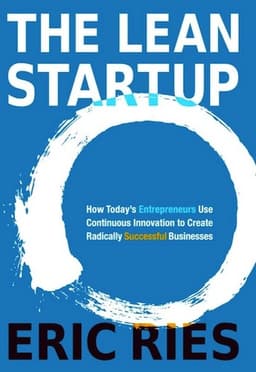
However, if you are looking for step-by-step tactical advice on running a startup, this is not that book. Pair it with The Lean Startup for a more complete picture.
Verdict
Zero to One is a short book that packs a disproportionate amount of intellectual firepower. Not every idea lands perfectly, and Thiel's libertarian worldview sometimes colours his arguments in ways that may not resonate with every reader. But the core thesis — that the most valuable companies create new things rather than copy existing ones — is a message the Indian startup ecosystem needs to hear. At 350 rupees, this book will challenge assumptions you did not even know you held.
Rating: 4.3 out of 5 — A thought-provoking read that rewards founders who are willing to question the obvious.