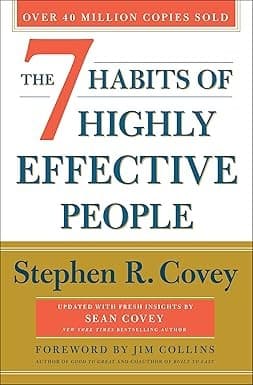
The 7 Habits of Highly Effective People
by Stephen R. Covey
A timeless classic that goes beyond productivity into personal effectiveness. Covey's principle-centered approach has helped millions prioritize what truly matters.
First published in 1989, Stephen R. Covey's The 7 Habits of Highly Effective People has sold over 40 million copies worldwide. Books do not endure for nearly four decades unless they touch something true. While the productivity landscape has exploded with apps, frameworks, and hacks, Covey's work remains relevant because it addresses something deeper than getting more done — it addresses becoming a more effective human being.
The Seven Habits at a Glance
Covey organises his seven habits into three stages of maturity:
Private Victory (Independence):
- Be Proactive — Take responsibility for your life. Stop blaming circumstances, conditions, or other people.
- Begin with the End in Mind — Define your personal mission and values before diving into daily tasks.
- Put First Things First — Spend your time on what is important, not just what is urgent.
Public Victory (Interdependence): 4. Think Win-Win — Seek outcomes that benefit all parties. Abundance mentality over scarcity. 5. Seek First to Understand, Then to Be Understood — Listen deeply before offering your perspective. 6. Synergize — Combine the strengths of people through positive teamwork to achieve goals no one could alone.
Renewal: 7. Sharpen the Saw — Continuously renew yourself across four dimensions: physical, mental, emotional, and spiritual.
The Time Management Matrix
One of the most enduring tools from the book is Covey's time management matrix, which divides activities into four quadrants based on urgency and importance. Most professionals spend their days trapped in Quadrant I (urgent and important — firefighting) and Quadrant III (urgent but not important — interruptions). The secret to effectiveness lies in Quadrant II — important but not urgent activities like planning, relationship building, learning, and prevention.
For Indian professionals, this matrix is a revelation. The Indian work culture often rewards visible busyness — staying late, responding to messages instantly, attending every meeting. Covey's matrix exposes the trap: being busy is not the same as being effective. The person who spends Sunday evening planning their week will outperform the person who arrives Monday morning reacting to whatever lands in their inbox.
Proactivity in the Indian Context
Covey's first habit — Be Proactive — is perhaps the most transformative for the Indian workplace. In hierarchical organisations, it is easy to fall into a reactive pattern: waiting for instructions, blaming the system, complaining about management. Covey argues that between stimulus and response, there is a space, and in that space lies your freedom to choose. This idea is remarkably aligned with the Gita's teaching on focusing on action rather than outcomes. Indian readers may find familiar philosophical echoes throughout the book.
Synergy and Team Dynamics
Habit 6, Synergize, is particularly relevant for Indian teams that are increasingly cross-functional and geographically distributed. Covey's point is not just about collaboration — it is about valuing differences. When a developer, a designer, and a product manager genuinely listen to each other and build on each other's ideas, the result is better than anything any one of them could produce alone. In a culture that sometimes prioritises hierarchy over contribution, this is a powerful reframe.
Does It Still Hold Up in 2026?
The honest answer is: mostly yes. The principles are timeless. The examples and language occasionally feel dated — Covey writes in a formal, almost paternal tone that may not resonate with younger readers. Some concepts, like the personal mission statement, can feel abstract without guided exercises. But the core framework — moving from dependence to independence to interdependence — is as relevant as ever.
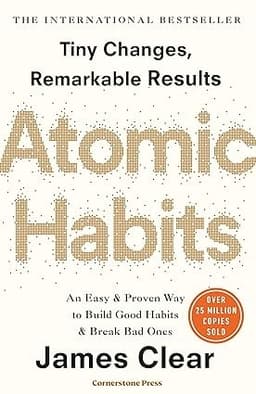
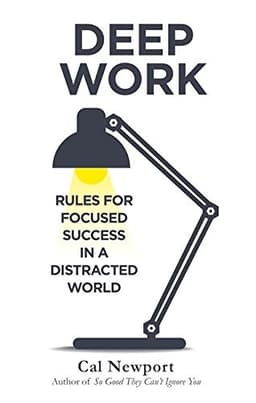
If you have read dozens of modern productivity books but never picked up this classic, you may be surprised to discover that many of the ideas you have encountered elsewhere originated here. Atomic Habits, Deep Work, and numerous other bestsellers build on foundations that Covey laid decades ago.
Final Verdict
The 7 Habits is not a quick-fix productivity book. It is a slow, deep read that asks you to examine your values, your relationships, and your purpose. For Indian professionals who feel caught on the treadmill of busyness, Covey offers a way off — not by doing more, but by doing what matters.
Rating: 4.4/5 — A timeless classic that rewards thoughtful, repeated reading.