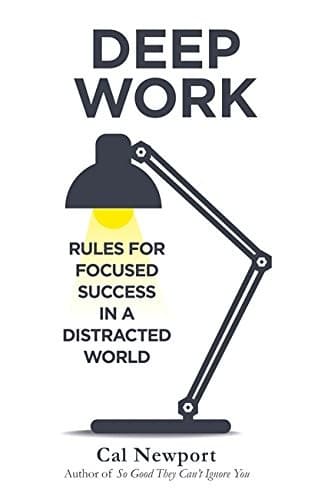
Deep Work
by Cal Newport
In a world of constant distraction, the ability to focus deeply is a superpower. Newport makes the case for deep work and provides practical strategies to achieve it.
Open any office floor in Bengaluru, Hyderabad, or Gurugram and you will find the same scene: rows of professionals toggling between Slack, email, Jira tickets, and a meeting that could have been an email. Cal Newport calls this "shallow work" — logistical tasks performed in a state of constant distraction. His book Deep Work makes a compelling argument that the real competitive advantage in today's knowledge economy belongs to those who can focus without distraction on cognitively demanding tasks.
Deep Work vs. Shallow Work
Newport defines deep work as professional activities performed in a state of distraction-free concentration that push your cognitive capabilities to their limit. These efforts create new value, improve your skill, and are hard to replicate. Shallow work, on the other hand, is the non-cognitively demanding, logistical-style work often performed while distracted — replying to emails, attending status update meetings, filling out forms.
The distinction is not about which tasks are important. It is about which tasks require your full cognitive power. Writing code, designing architecture, crafting strategy documents, analysing data — these are deep work. And most professionals spend shockingly little time doing them.
The Deep Work Hypothesis
Newport's central claim is bold: the ability to perform deep work is becoming increasingly rare at exactly the same time it is becoming increasingly valuable. If you can master this skill, you will thrive. If you cannot, you will be left behind. This is not speculation. Newport draws on research from psychology, neuroscience, and economics to build his case.
Strategies for Going Deep
The most valuable part of the book is the practical section on how to actually achieve deep work. Newport offers four scheduling philosophies:
- Monastic — eliminate all shallow obligations (extreme, but effective for academics and writers)
- Bimodal — dedicate defined stretches to deep work and leave the rest for shallow tasks
- Rhythmic — build a daily habit of deep work at the same time each day
- Journalistic — fit deep work wherever you can in a busy schedule
For most Indian IT professionals and managers, the rhythmic approach works best. Block two to three hours each morning before the meeting avalanche begins. Protect that time ruthlessly.
The Indian Open-Office Problem
Newport's arguments hit especially hard in the Indian context. Most Indian offices are open-plan, noisy, and culturally oriented toward constant availability. Saying "I cannot talk right now, I am doing deep work" can feel culturally awkward. Yet the cost of never doing deep work is enormous — stagnant skills, mediocre output, and the nagging feeling that you are always busy but never productive.
The book gives you language and frameworks to push back. You can propose "no-meeting mornings" to your team. You can use noise-cancelling headphones as a social signal. You can batch your email and Slack responses to specific times. These are small changes, but they protect the cognitive space where your best work happens.
Scheduling and Rituals
Newport is practical about building deep work into your life. He recommends scheduling every minute of your day — not to become rigid, but to become intentional. He also advocates for "shutdown rituals" at the end of each workday, where you review your tasks, plan tomorrow, and then completely disconnect. For professionals who carry their laptops home and answer emails at 11 PM, this is a radical idea. But it works. Your brain needs downtime to consolidate learning and recharge focus.
Who Should Read This
If you are a knowledge worker in India — software developer, analyst, designer, writer, researcher, or manager — this book is essential. It will change how you think about your workday and give you concrete tools to produce better work in less time.
The writing is clear and engaging, though Newport occasionally over-argues his points. Some readers may find the academic examples less relatable. But the core framework is powerful and immediately applicable.
Rating: 4.5/5 — A must-read for anyone whose work requires sustained concentration in a world designed to prevent it.