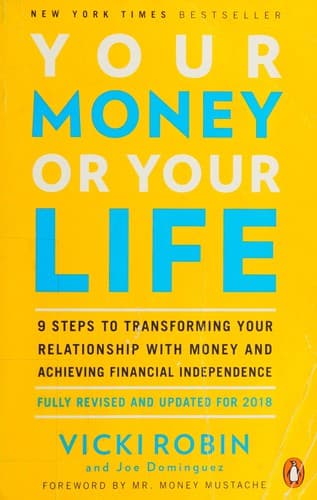
Your Money or Your Life
by Vicki Robin, Joe Dominguez
A timeless blueprint for financial independence that asks you to rethink your relationship with money entirely. Despite its American origins, the core framework translates powerfully for Indian professionals chasing FIRE.
The Question That Changes Everything
Picture this: you're stuck in Bengaluru traffic at 8:30 PM, heading home after a ten-hour day. You impulse-bought something on Amazon earlier — a gadget, a pair of shoes, whatever — and it cost ₹4,000. Now ask yourself: how many hours of your life did you actually trade for that purchase? Not your salary divided by work hours. Your real hourly rate, after taxes, commute time, work clothes, stress-fuelled Swiggy orders, and the weekend you need just to recover.
That question is the beating heart of this your money or your life book review india readers keep bookmarking — and once you've asked it, you genuinely cannot un-ask it.
What the Book Is Actually About
First published in 1992 and updated in 2008, this isn't a book about SIPs or mutual fund selection. Vicki Robin and Joe Dominguez argue that money is life energy made liquid — and most of us are trading it unconsciously and badly. The nine-step program walks you through calculating your true hourly wage, tracking every rupee you earn and spend, and building passive income until investments cover your expenses. That crossover point is financial independence.
It's closer to a philosophy book wearing a finance manual's clothes.
Three Ideas That Will Stick With You
The real hourly rate calculation is the book's most immediately useful tool. Take your monthly take-home pay, subtract every expense caused by your job — the office wardrobe, the Swiggy order because you're too depleted to cook, that gym membership bought purely to counter workplace stress — then divide by all the hours your job actually consumes, commute and mental bandwidth included. For most Indian IT professionals, this number drops 25–40% from what they assumed. That discomfort is precisely the point.
The concept of "enough" is genuinely countercultural. Robin argues there's a peak fulfillment curve in spending — below a certain point you're deprived, above it you're accumulating without any real satisfaction. Identifying your personal "enough" number is quietly liberating, particularly in a culture where lifestyle inflation follows every salary hike almost on autopilot.
Tracking spending without judgment ties it all together. Not to restrict yourself, but to make choices conscious. The reframe here is subtle but powerful: frugality stops being deprivation and becomes alignment between your money and your actual values.
How It Compares to Other Finance Books
Most personal finance books tell you to save more and invest wisely. This one asks why you're earning in the first place. Unlike Rich Dad Poor Dad — heavy on inspiration, lighter on mechanics — Your Money or Your Life gives you a concrete, repeatable system. And unlike purely numbers-driven reads, it forces an honest reckoning with work, identity, and what you actually want your days to look like.
It fills a gap that most Indian finance content doesn't touch.
Who Should Read This
This book is ideal for Indian professionals in their late 20s and 30s who feel vaguely trapped — earning well but not feeling financially free, wondering if the corporate treadmill is the only available road. It's especially valuable if you've been curious about FIRE but find most content too US-centric to feel actionable.
If you need specific Indian investment guidance — PPF vs NPS, index fund picks, real estate allocation — this isn't that book. It builds the mindset; you'll need other resources for the execution layer.
Applying It in the Indian Context
The examples are American, but the principles map cleanly. The true hourly rate concept works perfectly here — with India's longer commute times and the reality of supporting extended family, it often reveals an even starker gap than the book's original examples suggest. Building passive income until it covers expenses translates directly: dividend income, rental yield, or an index fund SWP (Systematic Withdrawal Plan) covering monthly expenses is exactly the crossover point Robin describes.
One honest flag: the book's original investment vehicle (US Treasury bonds) is outdated and irrelevant for Indian readers. Treat that section as a structural placeholder and substitute India-appropriate options like index funds or REITs.
Compare prices below to find the best deal on this book right now.
Final Verdict
This book won't tell you which stocks to buy. But it might fundamentally change why you're investing — and that shift in perspective is worth considerably more than any hot tip. If you've ever thought "I earn decent money, so why doesn't it feel like enough?", Your Money or Your Life has an answer worth sitting with.
Rating: 4.2/5 — A genuine classic that reframes your entire relationship with money. Slightly dated in places, but essential reading for anyone serious about financial independence in India.