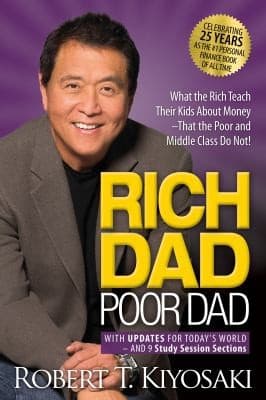
Rich Dad Poor Dad
by Robert Kiyosaki
The book that started the personal finance movement for millions. Kiyosaki's lessons about assets, liabilities, and making money work for you remain timeless.
Rich Dad Poor Dad by Robert Kiyosaki — A Mindset Shift That India Still Needs
Rich Dad Poor Dad is probably the most widely read personal finance book on the planet. It has sold over 32 million copies, been translated into dozens of languages, and sparked countless dinner table arguments about whether your house is an asset or a liability. Love it or criticize it, there is no denying that Robert Kiyosaki's 1997 classic fundamentally changed how an entire generation thinks about money. And for Indian readers, many of its core lessons remain uncomfortably relevant.
The Story: Two Fathers, Two Philosophies
The book is built around a simple narrative device. Kiyosaki had two father figures growing up in Hawaii. His biological father — the "poor dad" — was highly educated, held a government job, believed in working hard, saving money, and climbing the corporate ladder. His friend's father — the "rich dad" — never finished eighth grade but owned businesses, invested in real estate, and understood how money actually works. The poor dad worked for money. The rich dad made money work for him.
This framing, while oversimplified, is devastatingly effective. For an Indian reader, the "poor dad" archetype is instantly recognizable. He is the IAS officer who retires with a pension but no wealth. He is the engineering professor who spent 35 years in service and owns nothing but a house bought on a government loan. He is the middle-class father who told you to study hard, get a stable job, and save in FDs. There is nothing wrong with this path — but Kiyosaki's point is that it is not the only path, and understanding why is crucial.
Assets vs. Liabilities: The Lesson That Stings
The most famous idea in the book is Kiyosaki's definition of assets and liabilities. An asset puts money in your pocket. A liability takes money out of your pocket. By this definition, your self-occupied house — the one your parents spent their life savings on — is a liability. It generates no income, costs you property tax, maintenance, and insurance, and ties up capital that could be invested elsewhere.
This idea is borderline heretical in India, where home ownership is practically a religious obligation. "Apna ghar hona chahiye" is drilled into us from childhood. And yet, when you run the numbers, Kiyosaki has a point. A family that buys a 1.5 crore flat on a 20-year home loan at 8.5% interest will pay nearly 1.6 crore in interest alone — more than the cost of the house itself. That same money invested in a diversified equity mutual fund through SIPs could potentially generate significantly more wealth over the same period. This does not mean you should never buy a house. It means you should understand the financial trade-off you are making instead of treating it as an unquestionable good.
Financial Education: The Gap India Cannot Ignore
Kiyosaki's loudest argument is that schools teach you nothing about money. You learn trigonometry and the periodic table but graduate without understanding what a balance sheet is, how taxes work, or what compound interest does over 30 years. This criticism applies to India with even more force than it does to America. Our education system produces millions of engineers, doctors, and MBAs who cannot explain the difference between a term plan and an endowment policy, who do not know what ELSS stands for, and who hand their money to LIC agents without ever comparing alternatives.
The book advocates for self-directed financial education — reading, studying, and learning how money works, not just how to earn it. For Indian readers, this is actionable advice. The resources exist: SEBI's investor education portal, Varsity by Zerodha, books like Let's Talk Money by Monika Halan. The question is whether you will invest the time.
A Balanced Critique
It would be dishonest to review Rich Dad Poor Dad without acknowledging its weaknesses. The book is light on specifics. Kiyosaki tells you to "buy assets" but does not teach you how to evaluate a stock or structure a real estate deal. Some of his claims about his own wealth have been questioned. His later ventures, including seminars and branded products, have drawn criticism for being more about selling the Kiyosaki brand than genuinely educating people. And his writing style — repetitive, motivational, occasionally preachy — can grate on readers who prefer substance over slogans.
Moreover, some of his advice does not translate cleanly to the Indian context. Real estate investing in India is riddled with black money, unclear titles, and regulatory hurdles that make it fundamentally different from the American market Kiyosaki operates in. His emphasis on entrepreneurship, while inspiring, underplays the genuine risk involved, especially in a country without a strong social safety net.
The Bottom Line
Rich Dad Poor Dad is best understood as a starting point, not a finish line. It will not teach you how to invest. It will not give you a financial plan. What it will do is crack open a door in your mind — the realization that the "study hard, get a job, retire at 60" script is not the only way to live. For many Indian readers, especially those from salaried, middle-class families where money was never discussed openly, that single shift in perspective can be life-changing. Read it for the mindset, then move on to books that give you the tools to act on it.